

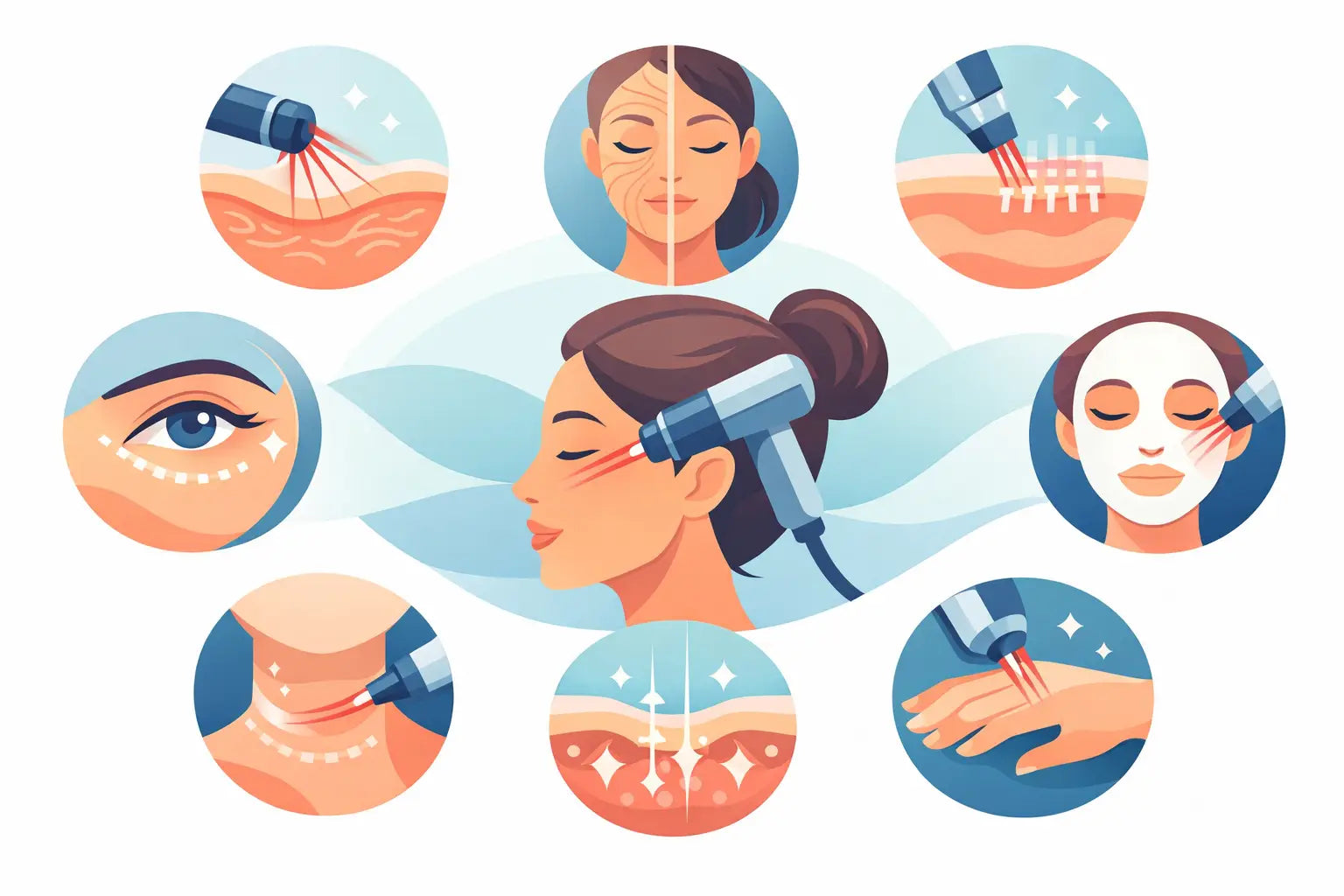
Crow’s feet can look different from lip lines. Forehead creases behave differently than early cheek laxity. That’s why looking at wrinkle laser treatment examples is more useful than talking about “laser resurfacing” as if it’s one thing. The right treatment depends on where the wrinkle sits, how deep it is, your tolerance for downtime, and whether you want an in-office procedure or a more consistent at-home approach.
For most people, the real question is not whether lasers can help with wrinkles. It’s which type of laser treatment matches the skin concern you actually see in the mirror, and what trade-offs come with that choice.
Why wrinkle laser treatment examples matter
Wrinkles are a collagen story, but not all collagen loss shows up the same way. Fine lines around the eyes usually need a different strategy than etched-in forehead lines or texture changes around the mouth. Some lasers focus on controlled injury to trigger remodeling. Others use gentler energy to stimulate collagen with less recovery.
That difference matters because results, comfort, and downtime vary widely. A treatment that can dramatically improve deeper lines may also require several days of redness, flaking, or social downtime. A gentler option may ask for more consistency but fit more easily into real life.
8 wrinkle laser treatment examples
1. Fractional ablative laser for etched-in texture and deeper lines
This is the category many people picture when they think of dramatic laser resurfacing. Fractional ablative lasers create microscopic columns of injury in the skin, removing portions of tissue while leaving surrounding skin intact to support healing.
This approach can be effective for more advanced wrinkling, especially around the mouth, cheeks, and areas with visible texture damage. The trade-off is recovery. Redness, swelling, peeling, and several days of visible downtime are common. It can be powerful, but it is not casual.
2. Non-ablative fractional laser for fine lines with less downtime
Non-ablative fractional treatments heat the skin below the surface without vaporizing the top layer in the same way ablative treatments do. They are often chosen for fine lines, mild to moderate texture concerns, and early signs of collagen loss.
Results tend to build over a series of sessions rather than appearing all at once. The upside is a lighter recovery period. If you want improvement but are not prepared for aggressive resurfacing, this is often the more realistic category to consider.
3. Under-eye laser treatment for crow’s feet and crepey skin
The eye area is where many people notice aging first, and it also happens to be one of the trickiest areas to treat well. Skin here is thinner, more delicate, and more reactive. Laser treatments used around the eyes are typically selected for precision and controlled collagen stimulation.
For mild to moderate crow’s feet, a gentler non-ablative approach may be enough to smooth the look of fine lines over time. For more advanced wrinkling, some providers may recommend a stronger resurfacing treatment, but downtime and sensitivity increase. This is a good example of why location matters as much as wrinkle depth.
4. Laser treatment around the mouth for smoker’s lines and lip lines
Vertical lip lines are often stubborn because the mouth is a high-movement area. Repetitive expression, collagen decline, and sun exposure all show up here quickly. Many in-office laser examples for this area use fractional resurfacing to improve the etched look of these lines.
The challenge is that stronger treatments around the mouth can be uncomfortable and may require noticeable healing time. Patients who want less disruption often look for lower-intensity collagen-stimulating options they can use more consistently, especially if the lines are still in the fine to moderate range.
5. Full-face laser rejuvenation for diffuse fine lines
Sometimes the concern is not one deep wrinkle but a general loss of smoothness. Fine lines across the cheeks, forehead, and around the eyes can make skin look older even before severe wrinkles set in. In these cases, full-face laser rejuvenation may be recommended to improve overall tone, texture, and firmness.
This category can include both in-office and at-home options. In-office versions may deliver faster visible change but often involve higher cost and more recovery. At-home laser devices are designed for repeated use, making them appealing for people who want to support collagen regularly without building their schedule around appointments.
6. Forehead wrinkle laser treatment for expression lines
Forehead lines can be dynamic at first, meaning they appear mainly with movement, and later become static, meaning they stay visible at rest. Laser treatment examples in this area often focus on improving skin texture and collagen support rather than changing muscle movement.
That distinction is important. If forehead lines are largely driven by expression, laser may soften their appearance by improving skin quality, but it will not work the same way a neuromodulator does. For static lines and crepey texture, collagen-stimulating laser treatments can be a strong fit. For very movement-driven lines, expectations should stay realistic.
7. At-home non-fractional laser for ongoing wrinkle reduction
This is one of the most relevant wrinkle laser treatment examples for people who want results without the cycle of repeated office visits. At-home non-fractional laser technology is designed to deliver controlled dermal heating that supports collagen production while keeping the skin surface intact.
That matters because the experience is fundamentally different from aggressive resurfacing. You are not trading several intense sessions for downtime. You are committing to regular use in exchange for convenience, comfort, and cumulative improvement. For busy professionals and skincare users who value consistency, this can be a smarter fit than waiting months between stronger treatments.
A clinically aligned at-home option can make even more sense when your goal is to treat common aging concerns early, before lines become deeply etched. This is where a device like NIRA fits naturally into a modern anti-aging routine - not as a copy of ablative resurfacing, but as a high-performance collagen strategy designed for real life.
8. Combination laser treatment for wrinkles plus firmness concerns
Not everyone is dealing with wrinkles alone. Often the complaint is a mix of fine lines, rough texture, and mild sagging. In those cases, laser treatment may be part of a broader plan that includes topical skincare, sun protection, and possibly additional in-office treatments depending on severity.
This is the example that shows why no laser should be judged in isolation. A laser can stimulate collagen, but skin quality is also affected by hydration, inflammation, barrier health, and daily UV exposure. The best results usually come from matching the treatment to the full picture, not just the wrinkle.
How to choose between these wrinkle laser treatment examples
Start with severity. If your lines are still fine and mostly visible in certain lighting or facial expressions, a gentler collagen-building approach may be enough. If wrinkles are deeply set and paired with significant texture change, stronger in-office resurfacing may offer a larger jump in visible improvement.
Then think about downtime honestly. Many people say they want maximum results, but not everyone wants a week of redness or the unpredictability of post-treatment recovery. Convenience is not a minor factor. It often determines whether you follow through.
Skin tone and sensitivity also matter. Some laser categories require more caution for certain skin types because of pigmentation risk or post-inflammatory changes. A treatment that is ideal for one person may not be the best starting point for another.
Finally, consider your time horizon. If you want a dramatic intervention for advanced signs of aging, in-office treatment may be worth the investment. If you want steady wrinkle reduction that fits into your routine and supports skin over time, at-home laser technology can be a more sustainable path.
What results should you realistically expect?
Laser treatments can improve the look of wrinkles, but they do not stop skin from aging. Collagen stimulation is real, but it is gradual. Even stronger resurfacing usually unfolds over healing and remodeling, while gentler laser options depend on repeated use.
The people happiest with laser are usually the ones who understand this from the start. They are not looking for overnight perfection. They are looking for smoother texture, softer lines, firmer-looking skin, and a treatment plan they can actually maintain.
That is why examples matter. They turn a vague category into a practical decision. Once you know whether you are treating crow’s feet, lip lines, forehead creases, or general collagen loss, the right laser path becomes much easier to see. Choose the option that fits your skin, your schedule, and your tolerance for downtime, and you are far more likely to stay consistent long enough to see meaningful change.


