

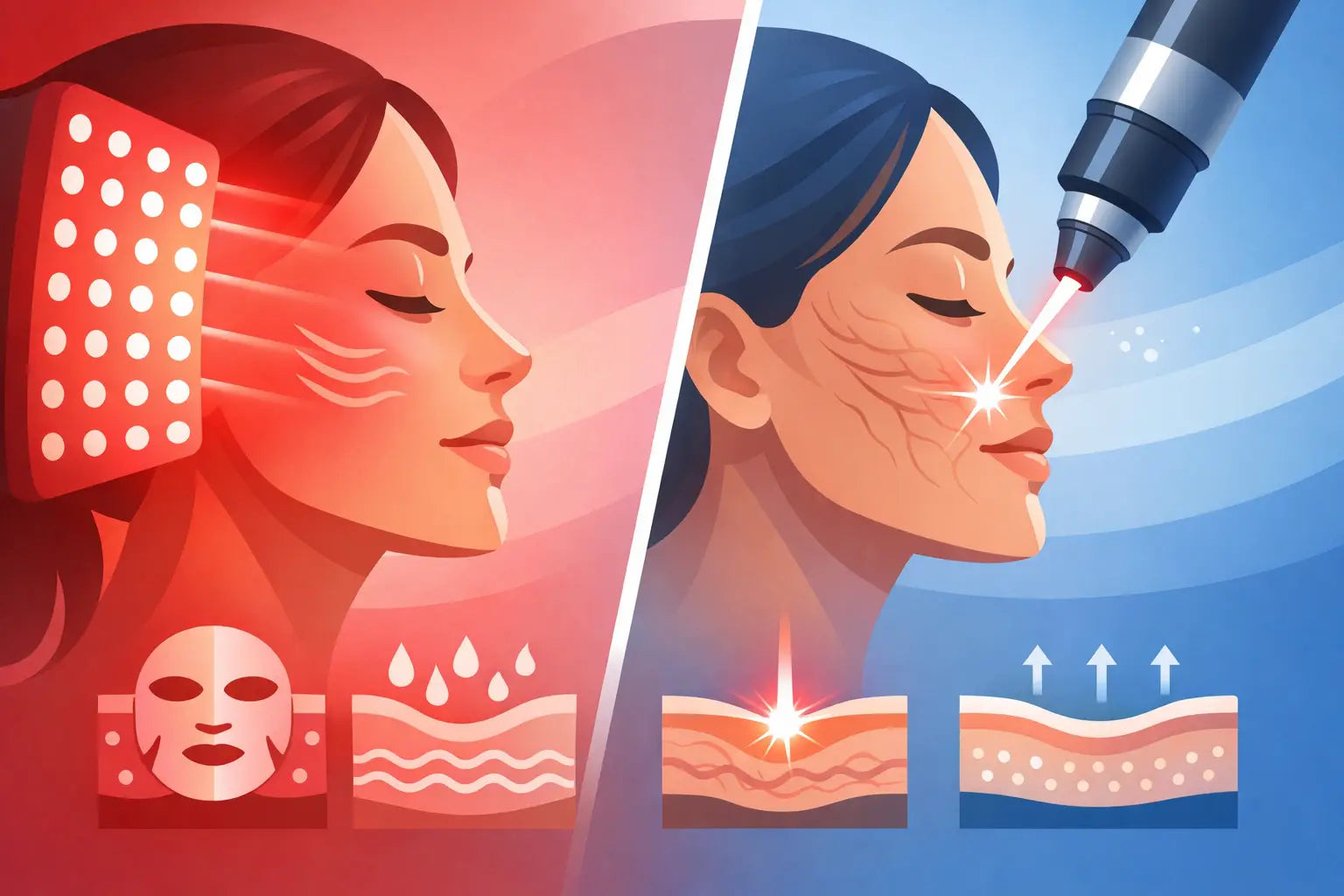
If you’re comparing red light therapy vs laser for wrinkles, you’re already asking a smarter question than most skincare marketing wants you to ask. These treatments are often grouped together because both use light-based technology, but they do not work the same way, and they do not typically deliver the same level of wrinkle reduction.
That distinction matters when your goal is visible change. If you want a relaxing add-on to your routine, one category may fit. If you want a more targeted collagen-stimulation treatment with clearer anti-aging intent, the other may make more sense. The best choice depends on how deep your wrinkles are, how quickly you want to see improvement, and how much performance you expect from an at-home device.
Red light therapy vs laser for wrinkles: the core difference
The simplest way to understand the difference is this: red light therapy uses broad, lower-energy light, while laser uses focused light at a specific wavelength. Both can support skin rejuvenation, but they interact with the skin differently.
Red light therapy, often delivered through LED masks and panels, exposes the skin to wavelengths designed to support cellular activity. It is generally positioned as a gentle treatment that may help with overall skin appearance, mild inflammation, and early signs of aging. Because the light is not concentrated in the same way as a laser, its effects tend to be more subtle and cumulative.
Laser technology is more precise. It sends concentrated light energy into the skin in a controlled way to stimulate collagen production more directly. That precision is why lasers have long been associated with wrinkle treatment in dermatology settings. It is also why at-home laser devices, when engineered for safety and consistency, are often chosen by people who want more than a general wellness-style glow.
This is where many consumers get tripped up. Light is not one category. A red LED mask and a wrinkle-focused laser device may both light up, but that does not mean they perform equally.
How red light therapy works on aging skin
Red light therapy is typically marketed as a noninvasive way to support the skin’s natural repair processes. The idea is that red and near-infrared wavelengths may encourage better cellular function, which can help skin look calmer, fresher, and slightly more radiant over time.
For wrinkles, the promise is usually indirect. Red light therapy may help support collagen and reduce the look of mild fine lines, especially when used consistently over weeks or months. People often like it because it is easy to use, generally comfortable, and simple to add to a broader skincare routine.
That said, the trade-off is performance. If you have established wrinkles, visible creasing around the eyes, or skin that is showing more obvious collagen loss, red light therapy may feel too gentle. It can be a reasonable maintenance tool, but it is not always the strongest option for someone looking for more dramatic or targeted wrinkle correction.
How laser technology targets wrinkles
Laser devices take a more focused approach. By delivering a controlled wavelength into the skin, they are designed to trigger a repair response that helps stimulate collagen and improve the appearance of lines and wrinkles.
Not all lasers are the same, which is an important nuance. In-office lasers can be aggressive, with downtime, redness, and a higher level of commitment. At-home lasers are designed differently. The strongest at-home options are built to deliver effective wrinkle-focused treatment while staying within a safety profile that works for regular consumer use.
For wrinkle concerns, this precision matters. Skin aging is not just a surface issue. As collagen declines, the skin loses firmness and structure. A technology that is specifically designed to stimulate collagen in a targeted way is often more aligned with that problem than a broader light treatment meant to generally support skin health.
Which delivers better wrinkle results?
For true wrinkle reduction, laser usually has the advantage.
That does not mean red light therapy has no place. It can be appealing for early prevention, for people who want a very gentle device, or for those who enjoy a spa-like ritual. But when consumers compare red light therapy vs laser for wrinkles, they are usually not asking which feels nice. They are asking which has the better chance of delivering visible improvement.
In that comparison, laser tends to be the more results-driven category because it is more precise and more intentionally built for collagen stimulation. If your goal is softening crow’s feet, reducing forehead lines, or improving skin firmness in a meaningful way, a well-designed laser device is often the more compelling choice.
This is especially true for shoppers who are already past the stage of hoping a serum alone will handle the issue. Once wrinkles are etched in more clearly, treatment intensity and specificity start to matter more.
Red light therapy vs laser for wrinkles at home
At-home treatment has changed the conversation because convenience now matters almost as much as efficacy. Most people do not want repeated office appointments, long recovery periods, or the cost of ongoing professional procedures. They want something they can actually keep up with.
Red light therapy at home is widely accessible. LED masks and panels are common, and the user experience is usually passive. You wear the device, wait for the treatment cycle to finish, and repeat the process regularly. That simplicity is part of the appeal.
At-home laser devices are more performance-oriented. They are typically designed for short, consistent sessions and a more active treatment approach. For the right user, that trade-off is worth it. You may spend a few focused minutes using the device, but the goal is not just general skin support. The goal is visible wrinkle reduction.
This is where premium at-home beauty tech stands apart. A clinical-grade approach to home use gives consumers access to dermatologist-aligned technology without the price and disruption of in-office treatment plans. For many women balancing work, family, and everything else on the calendar, that is not a minor benefit. It is the reason they will actually stay consistent enough to see results.
Safety, comfort, and downtime
Comfort matters, especially if you plan to use a device long term.
Red light therapy is generally perceived as very gentle. Most users experience little to no discomfort, and downtime is not part of the experience. That makes it approachable for first-time beauty device shoppers.
Laser can sound more intimidating than it is, largely because people associate the word with aggressive resurfacing treatments in medical offices. But modern at-home wrinkle lasers are not the same as high-intensity clinical procedures. When properly engineered, they are designed to be safe, manageable, and easy to use as part of a routine.
The real question is not whether one is softer and one is stronger. It is whether the level of treatment matches your goal. If you want the gentlest possible experience, red light therapy may appeal more. If you want stronger wrinkle-focused technology without committing to office visits, at-home laser often offers a better balance of comfort and results.
Who should choose red light therapy?
Red light therapy may be the better fit if your concerns are mild, your skin goals are broad, or you want a low-commitment starting point. It can work well for someone in the early stages of anti-aging who wants to support skin appearance and create a more consistent self-care routine.
It may also appeal to people who prefer a passive treatment style and are comfortable with slower, subtler results. If your expectation is improvement around overall radiance rather than meaningful wrinkle correction, that can be a realistic match.
Who should choose laser for wrinkles?
Laser is usually the stronger choice for someone who is actively trying to reduce visible wrinkles, improve firmness, and support collagen where age-related change is already showing up. If you are investing in skincare because you want to see real difference in the mirror, not just feel like you are doing something helpful, laser is often the more strategic category.
It is especially appealing for consumers who want dermatologist-inspired technology at home. That audience tends to care about evidence, precision, and efficiency. They are not looking for another beauty gadget that ends up in a drawer. They want a device that feels purposeful and advanced.
That is exactly why clinically proven at-home laser has gained traction. It speaks to the consumer who wants visible results without making skin rejuvenation a part-time job.
The smarter way to decide
Instead of asking which technology is more popular, ask which one is built for your actual goal. If your priority is gentle maintenance, red light therapy may be enough. If your priority is wrinkle reduction with more targeted collagen support, laser is the category to look at more closely.
There is no value in choosing the softer option if it leaves you underwhelmed. And there is no need to overcomplicate the decision. The right device should fit your life, your skin, and your expectations.
For many people, that means moving beyond general light therapy and choosing a treatment with more precision behind it. When confidence is tied to visible change, the technology matters. So does choosing one that was designed to do more than glow.


