

Crow’s feet that remain after a good night’s sleep, lipstick lines that settle in by lunchtime, and creases around the mouth are all signs that skin is losing collagen and elasticity. The laser vs microneedling wrinkles decision comes down to more than which treatment sounds more advanced. It is about the type of wrinkles you see, your tolerance for downtime, your skin tone, and whether you want a professional procedure or a consistent at-home routine.
Both treatments can support smoother, firmer-looking skin. But they stimulate collagen in very different ways, and the best choice is rarely one-size-fits-all.
Laser vs Microneedling Wrinkles: The Core Difference
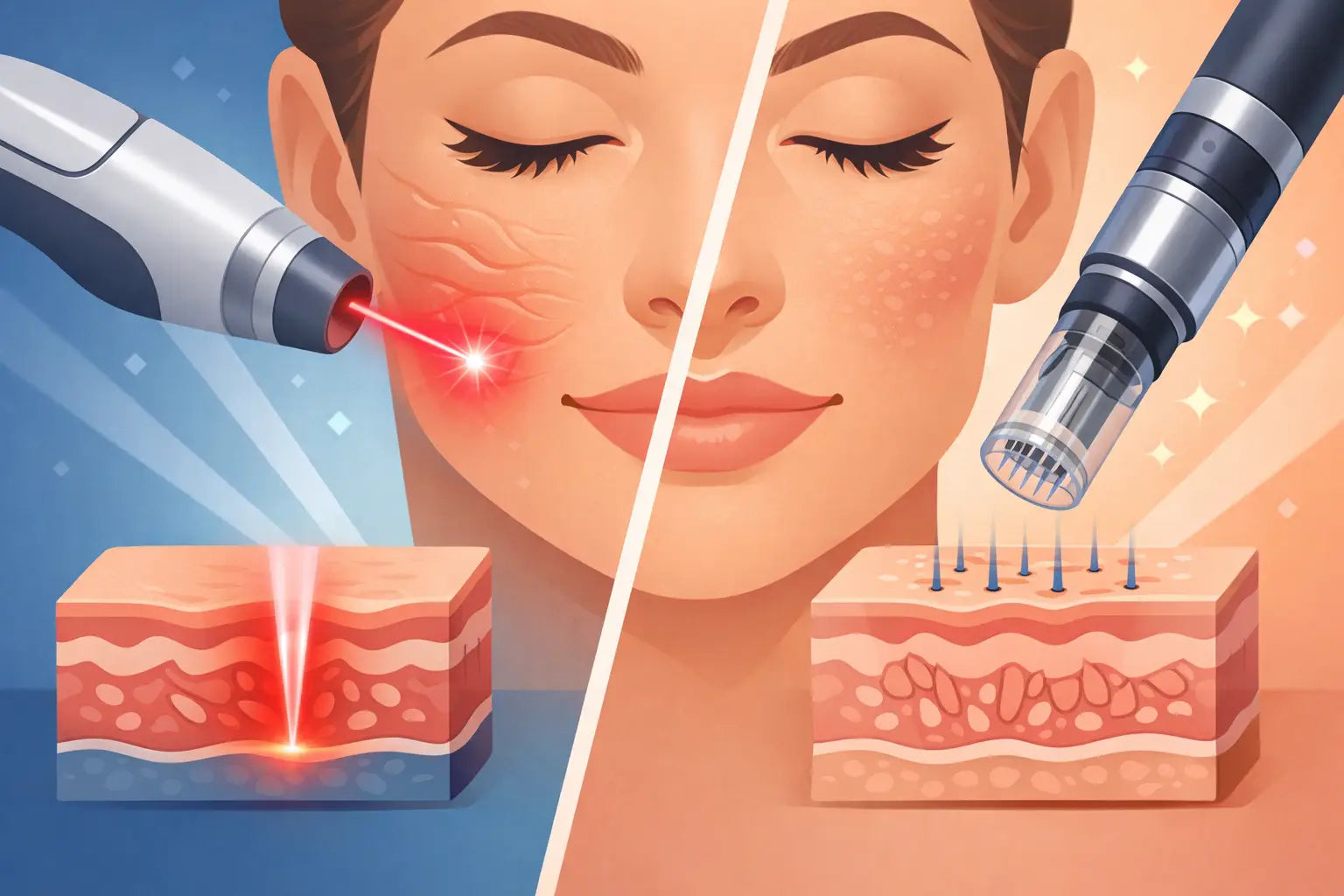
Laser treatments use controlled light energy to create heat within targeted layers of the skin. That heat signals the skin’s repair response, encouraging new collagen production and remodeling existing collagen. Depending on the laser, treatment can focus near the surface, deeper in the dermis, or both.
Microneedling works through controlled mechanical stimulation. Fine needles create tiny channels in the skin, triggering a wound-healing response that can support collagen and elastin production. In a professional setting, needle depth can be tailored to the area and concern being treated.
Both approaches rely on the same biological principle: your skin responds to a controlled stimulus by building and reorganizing supportive structure. The experience, recovery, precision, and treatment schedule are where they begin to differ.
When Laser May Be Better for Wrinkles
Laser can be especially compelling when wrinkles are tied to visible textural changes, sun damage, or overall loss of firmness. Light-based treatments can address more than lines alone, depending on the technology used. Some in-office lasers also improve uneven tone, photodamage, enlarged-looking pores, and roughness alongside wrinkles.
Not all lasers are alike. Ablative fractional lasers remove microscopic columns of skin and can produce significant resurfacing results, but they also involve more recovery and a higher level of aftercare. Non-ablative lasers heat tissue without removing the skin’s surface, usually with less downtime but often through a series of treatments. At-home non-fractional laser technology takes a different approach, delivering controlled energy designed for frequent, convenient use without the recovery associated with aggressive resurfacing.
For fine lines around the eyes and mouth, consistency matters. These areas move constantly through smiling, squinting, sipping, and sleeping, so collagen support often needs to be ongoing rather than a once-a-year event. An at-home device can fit naturally into that long-term strategy. NIRA’s clinical-grade at-home laser technology is designed around this model, helping users target visible wrinkles with a quick routine that supports collagen over time.
Laser may be a strong fit if you want to treat fine lines with precision, prefer not to schedule repeated office visits, or are looking for a technology-forward addition to a serious anti-aging routine.
What results can you expect from laser?
Results depend on the technology, treatment intensity, the condition of your skin, and your consistency. With professional laser resurfacing, the initial improvement may be more dramatic, followed by continued collagen remodeling over several months. With gentler non-ablative or at-home laser use, changes are more gradual. Skin may look smoother, feel firmer, and show softer-looking fine lines as collagen support builds.
The trade-off is straightforward: greater treatment intensity can bring more downtime and more risk, while gentler technology generally asks for patience and consistent use.
When Microneedling May Be Better for Wrinkles
Microneedling is often chosen for diffuse texture concerns, fine lines, and early signs of collagen loss. It can be particularly useful when someone wants a professional collagen-induction treatment without using light or heat energy. It is also commonly paired with specific topical products after treatment, although only products recommended by a qualified provider should be used on freshly treated skin.
For wrinkles, professional microneedling is generally more relevant than an at-home roller. At-home rollers are difficult to keep sterile, may create uneven pressure, and do not offer the controlled depth of a medical-grade device. A trained provider can adjust treatment depth based on the facial area, since thin under-eye skin and thicker cheek skin require different approaches.
Microneedling may be the right direction if your provider believes mechanical collagen stimulation suits your skin, you are comfortable with a short period of redness, and you can commit to a series of appointments. Most people need multiple sessions, spaced weeks apart, before assessing their result.
What results can you expect from microneedling?
Immediately after treatment, skin can look red, feel warm, and appear temporarily plumped. That initial glow is not the final result. The more meaningful changes develop gradually as collagen remodeling occurs. Fine lines may look softened, and skin texture may appear more refined after a treatment series.
Microneedling is not a substitute for a facelift, injectable treatment, or deep laser resurfacing. It is best understood as a collagen-building procedure that can improve the quality of skin over time. Deep etched wrinkles, particularly those formed by decades of repetitive movement, may need a broader treatment plan.
Downtime, Comfort, and Convenience
For many people, this is the deciding factor. In-office microneedling typically causes redness for one to several days, depending on needle depth and individual sensitivity. Skin may feel dry, tight, or mildly swollen. Makeup, exercise, sun exposure, and active skincare ingredients may need to be paused temporarily.
Laser downtime varies dramatically. Aggressive ablative resurfacing can require significant recovery, while some non-ablative treatments have only mild redness or swelling. At-home non-fractional laser devices are designed for a different lifestyle: brief sessions, no major interruption to work or social plans, and a routine that can be repeated consistently.
Comfort also varies by person and technology. Professional microneedling often involves topical numbing. In-office laser may feel like heat, snapping, or prickling. At-home laser use is typically designed to be manageable in a self-care routine, but users should always follow the device instructions and stop if they experience unexpected irritation.
Skin Tone and Safety Considerations
Skin tone deserves a real conversation, not a footnote. Heat-based treatments can carry a risk of post-inflammatory hyperpigmentation, particularly for deeper skin tones and with more aggressive laser settings. The risk does not mean laser is automatically off the table. It means the specific device, wavelength, settings, provider expertise, and pre- and post-treatment care matter greatly.
Microneedling is often considered an option for a broad range of skin tones because it does not rely on pigment-targeting light energy. However, it is not risk-free. Improper technique, excessive needle depth, poor sanitation, active acne, infection, a history of problematic scarring, or treating irritated skin can lead to complications.
Before any professional procedure, disclose melasma, hyperpigmentation, rosacea, cold sore history, current prescriptions, recent tanning, and prior reactions to skincare treatments. If you are considering an at-home device, review contraindications carefully and use daily broad-spectrum sunscreen. Collagen-focused treatment without sun protection is an uphill climb.
Cost: A Single Procedure vs a Long-Term Routine
Professional laser resurfacing and microneedling can both become meaningful investments, especially because one session is rarely the complete plan. Costs vary by city, provider, technology, treatment area, and whether numbing, post-treatment products, or combination treatments are included.
Microneedling usually involves a package of appointments. Professional laser may require fewer sessions at a higher per-treatment cost, depending on intensity. An at-home laser requires an upfront device investment, but it shifts the treatment model from recurring appointment costs to a consistent routine performed on your schedule.
The best value is not necessarily the lowest price per session. It is the option you can use safely, consistently, and realistically enough to see meaningful improvement.
How to Choose Between Laser and Microneedling
Start with the wrinkle itself. Fine lines from early collagen loss may respond well to either approach. Crepey texture and surface-level sun damage may make laser especially appealing. Acne scars or uneven texture may lead a provider to recommend microneedling, laser, or a combination plan. Deep expression lines may also require treatments that address muscle movement or volume loss, not collagen alone.
Then consider your lifestyle. If you want a more intensive reset and can accommodate recovery, an in-office procedure may make sense. If you want to build collagen support into your everyday life with minimal disruption, an at-home laser routine can be a powerful, practical path.
A thoughtful choice begins with realistic expectations. Choose the treatment that matches your skin, your schedule, and your willingness to stay consistent - because the most rewarding wrinkle results are built over time, one collagen-supporting decision at a time.


