

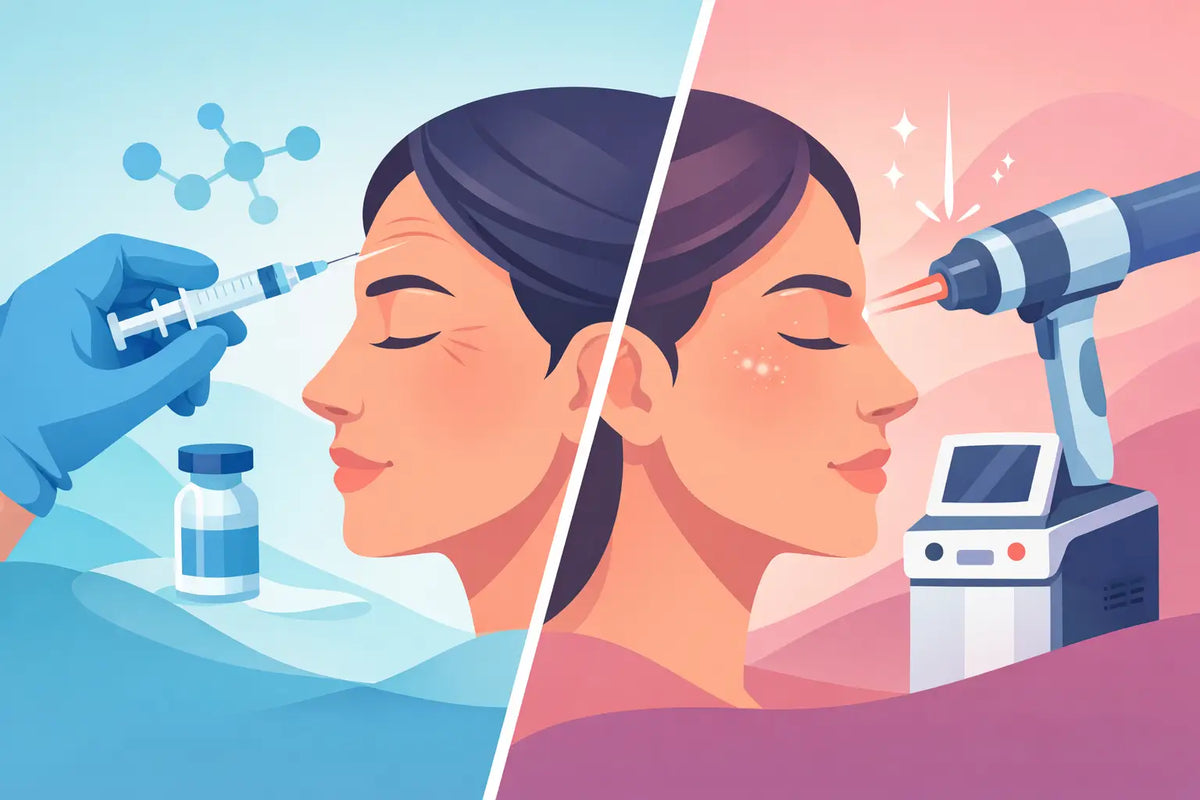
The decision between Botox vs laser wrinkles is not really about choosing the “stronger” treatment. It is about matching the technology to the type of lines you see in the mirror. A smooth forehead at rest, crow’s feet that appear only when you smile, crepey skin around the eyes, and deeper folds caused by collagen loss do not respond to treatment in the same way.
Botox and laser treatments can both be valuable parts of an anti-aging plan, but they work through entirely different mechanisms. One temporarily relaxes targeted facial muscles. The other uses controlled light energy to support collagen production and improve the skin itself. Understanding that difference can help you invest with more confidence.
Botox vs Laser for Wrinkles: The Core Difference
Botox is an injectable neuromodulator. When placed by a qualified medical professional, it temporarily reduces muscle movement in specific areas of the face. It is most commonly used for dynamic wrinkles, which are the lines created by repeated expressions such as frowning, squinting, or raising your eyebrows.
If the lines between your brows become pronounced when you concentrate, or your crow’s feet deepen when you laugh, Botox may soften the movement that causes those lines to crease. Results typically begin to appear within several days, with full effects often visible at about two weeks. The result is temporary, and many people repeat treatment every three to four months to maintain it.
Laser wrinkle treatments take a skin-focused approach. Laser energy is delivered into the skin to create a controlled biological response that supports collagen and elastin, the structural proteins associated with firm, smooth-looking skin. As collagen remodels over time, many people see improvements in fine lines, skin texture, overall radiance, and the appearance of laxity.
That distinction matters: Botox changes how a muscle moves. Laser treatment works to improve the quality and resilience of skin. Neither is automatically better. They are designed to address different concerns.
When Botox Makes the Most Sense
Botox can be a highly effective option when expression lines are the main issue. Forehead lines, frown lines, and crow’s feet often respond well because they are closely connected to repetitive muscle contraction.
Its biggest advantage is precision. An experienced injector can target a specific muscle pattern and create a tailored result, from a subtle softening of lines to a more dramatic reduction in movement. For someone preparing for an event, the relatively predictable timeline can be appealing.
There are trade-offs. Botox does not directly stimulate collagen, resurface texture, reduce the look of pores, or improve crepey skin. It also requires injections and continued appointments. Results fade as muscle activity gradually returns, so maintenance is part of the commitment.
The quality of the outcome depends heavily on technique. Too much product or poor placement can lead to an unnatural appearance, asymmetry, or unwanted heaviness in certain areas. Choosing a properly licensed, experienced injector is essential.
When Laser Treatment Is Better for Wrinkles
Laser treatment is often the more relevant choice when your concern is broader than expression lines. Fine lines that remain visible when your face is relaxed, uneven texture, loss of firmness, and thin-looking skin are often connected to changes in collagen over time.
Professional laser treatments range from more intensive ablative procedures, which remove portions of the skin’s surface and can involve substantial downtime, to non-ablative treatments that heat targeted layers without removing the surface. At-home laser technology uses a different treatment profile than in-office devices, designed for consistent, convenient use within its specified protocol.
For the right user, an at-home non-fractional laser can be especially compelling because collagen support is not a one-time goal. Skin changes gradually, and a treatment you can use regularly may fit more naturally into a long-term skincare plan than recurring clinic visits.
Results are not usually immediate in the way Botox can be. Collagen remodeling takes time. With consistent use, improvements may develop over weeks and continue to build over months. That slower pace is a trade-off, but it reflects the fact that laser treatment is working with the skin’s natural renewal processes rather than temporarily limiting a muscle’s movement.
Can You Combine Botox and Laser Treatments?
Yes. Many people choose both because dynamic wrinkles and collagen-related aging often coexist. Botox may reduce the repetitive movement that etches lines into the skin, while laser treatments can help improve the appearance of the skin around those lines over time.
For example, someone may use Botox for deeper forehead movement while using a laser-based routine to address fine lines around the eyes, texture, and firmness. The treatments are complementary when used appropriately, not competing solutions.
Timing matters. If you receive injectables or in-office procedures, ask your treating clinician when to resume or begin an at-home laser routine. A professional who understands your skin history, medications, and treatment plan can provide guidance that is specific to you.
Results, Cost, and Commitment Compared
The best option often comes down to what you want to improve and how you prefer to maintain results.
Botox is appointment-based. You pay per treatment, need a qualified injector, and will likely return several times a year if you want continued wrinkle-softening effects. It can create a noticeable change in dynamic lines relatively quickly, but the benefit is temporary.
Laser treatment is a skin investment. In-office treatments can involve a series of sessions, recovery time depending on the modality, and a meaningful financial commitment. A clinical-grade at-home device may offer a more convenient path for those who want to support collagen without arranging repeated office visits. The initial purchase can be significant, but the ability to maintain a consistent home routine may change the long-term value equation.
Topical skincare still has a role, too. Daily broad-spectrum sunscreen is non-negotiable because ultraviolet exposure accelerates collagen breakdown and can undermine the progress of any wrinkle treatment. Hydrating ingredients, peptides, retinoids when appropriate, and antioxidant formulas can complement a laser routine by supporting the skin barrier and improving surface-level hydration.
Safety Considerations Before You Choose
Botox should only be administered by a licensed, qualified medical professional. Be transparent about your health history, previous injectable treatments, allergies, and medications. Pregnant or breastfeeding individuals should speak with their clinician before considering cosmetic injectables.
Laser devices should always be used exactly as directed. Not every device is appropriate for every person or every skin concern, and individual device indications matter. Check whether a device is FDA-cleared for its intended use, follow the recommended treatment schedule, and do not treat irritated, broken, or recently sunburned skin.
If you have an active skin condition, a history of photosensitivity, are taking medication that increases light sensitivity, or recently had a cosmetic procedure, seek professional guidance before using laser technology. This is also wise if you are prone to hyperpigmentation or are unsure whether a wrinkle is caused primarily by muscle movement, skin laxity, or both.
A simple way to assess your wrinkles
Look at your face in relaxed, natural light. If a line appears mainly when you animate your face, it may be dynamic and more responsive to Botox. If it remains visible while your face is at rest, or if the surrounding skin looks thin, textured, or less firm, collagen-focused laser treatment may deserve a place in your routine.
Many people have both types. That is normal, and it is why an either-or mindset can be limiting.
Choosing a Treatment That Fits Your Real Life
The most effective wrinkle strategy is the one you can follow consistently and comfortably. Botox may be the right choice for targeted expression lines and fast, temporary refinement. Laser technology may be the better fit if your goal is to improve fine lines, texture, and firmness through a routine that supports ongoing collagen renewal.
For people who value clinical-grade technology without the recurring disruption of appointments, a consistent at-home option such as NIRA can make advanced wrinkle care feel more achievable. Start with the concern you want to change, protect your skin daily, and choose a plan that you will be happy to maintain long after the first visible improvement.


