

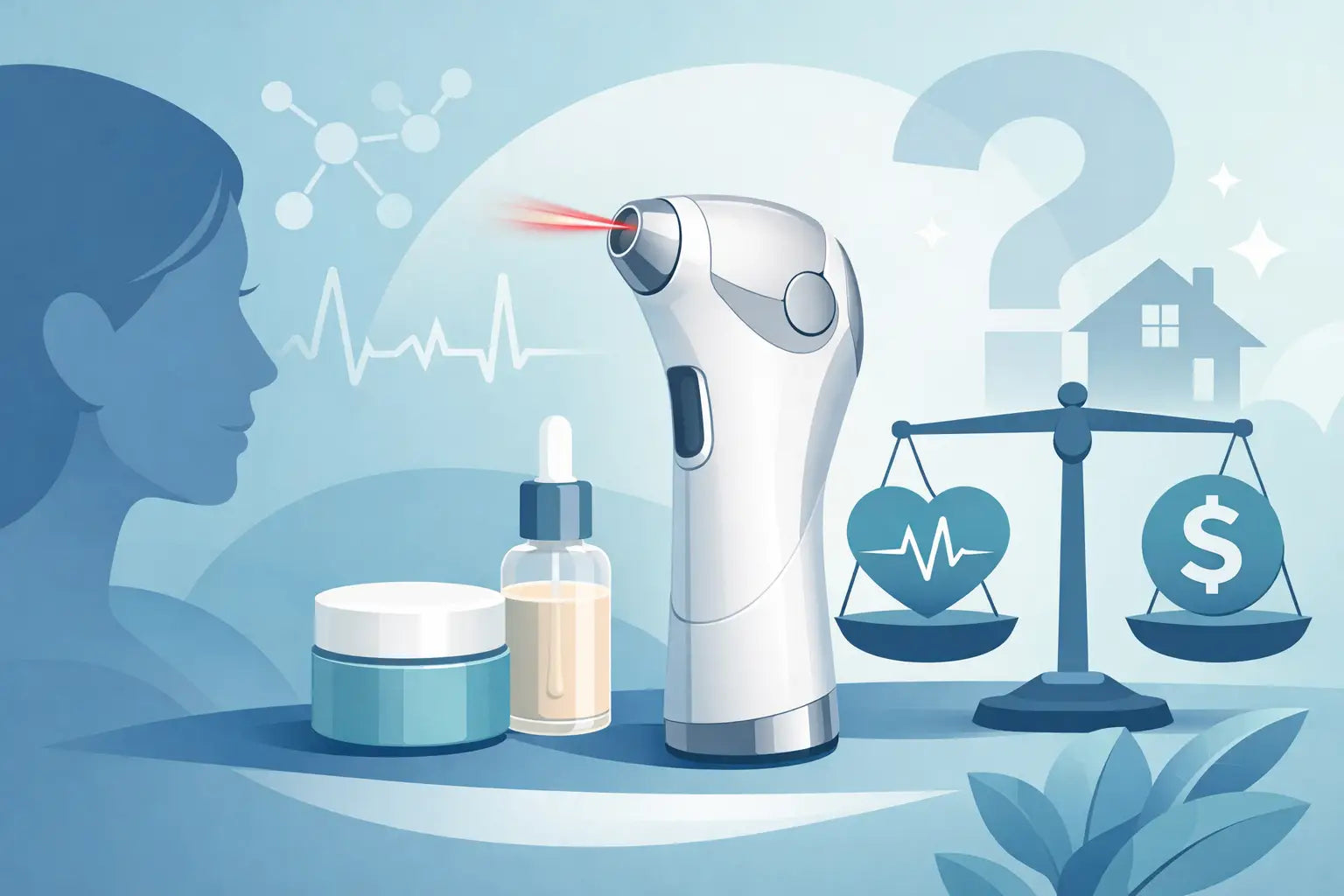
If you have ever priced out a series of in-office laser treatments, you already know the real question is not whether laser technology works. It is whether a clinical grade home laser can deliver meaningful wrinkle reduction and firmer-looking skin without the time, cost, and upkeep of repeated appointments.
That question matters because not all at-home devices are built to do the same job. Some are designed for surface-level support. Others are engineered to stimulate a deeper skin response tied to visible anti-aging results. When shoppers compare lasers, LED masks, microcurrent tools, and topical skincare, the difference often comes down to one thing: does the technology create a response strong enough to change the look of skin over time?
What a clinical grade home laser really means
A clinical grade home laser is not just a beauty gadget with a premium price tag. The phrase points to a device designed around medical-style laser principles, adapted for safe use at home. That usually means carefully controlled energy delivery, a specific wavelength, and a treatment profile intended to support visible skin renewal rather than just temporary surface effects.
For anti-aging, the goal is typically thermal stimulation below the skin’s surface. When laser energy reaches the right depth in a controlled way, it can help trigger the natural repair response that supports collagen and elastin. That is why this category appeals to people dealing with fine lines, deeper wrinkles, texture changes, and early skin laxity. The treatment is not trying to mask aging. It is trying to encourage skin to behave younger.
Still, the term can be used loosely in the market. Some devices lean heavily on the language of professional performance without offering meaningful clinical proof, safety validation, or a treatment mechanism that matches the claims. That is why the best way to evaluate a device is not by the phrase alone, but by the technology behind it, the consistency of use it requires, and the evidence supporting visible results.
How a clinical grade home laser works on wrinkles
Wrinkles form for more than one reason. Repeated facial movement creates expression lines, but collagen loss is what makes those lines settle in and become harder to treat with skincare alone. As skin ages, it becomes thinner, less resilient, and slower to repair itself. That is where laser-based treatment has an advantage.
A clinical grade home laser is designed to deliver focused light energy into the skin to create gentle heat in targeted tissue. That heat can stimulate the skin’s natural renewal process, which includes collagen production. Over time, this can help soften the look of lines, improve firmness, and create a smoother overall skin texture.
The distinction that matters here is non-fractional versus more aggressive treatment styles. Fractional lasers create microscopic zones of injury and often come with more downtime. Non-fractional approaches can be more appealing at home because they are designed to stimulate renewal without the same level of disruption to the skin barrier. For many consumers, that trade-off is exactly the point. They want visible results, but they also want a treatment they can fit into real life.
Why at-home laser has become a serious alternative
The appeal of at-home treatment is not hard to understand. Convenience matters, but convenience alone does not justify a premium device. What makes the category compelling is the combination of regular access and cumulative results.
In a clinic, even highly effective treatments are often spaced out because of cost, scheduling, and recovery. At home, a well-designed laser can be used consistently, which is essential for collagen-focused treatment. Skin remodeling is not immediate. It happens gradually as the skin responds to repeated stimulation over weeks and months.
That consistency can be a major advantage for someone who wants long-term wrinkle care without building her calendar around appointments. It also changes the economics. A single device can cost less than a package of in-office treatments, especially when maintenance is part of the equation.
The trade-off is speed and intensity. In-office treatments may produce faster or more dramatic changes because they can use higher-energy protocols under professional supervision. A home device is built with a different safety profile. Results may take longer, and they depend more heavily on sticking to the routine. For the right user, that is a fair exchange. For someone who wants a one-and-done transformation, it may not be.
What separates a good device from a forgettable one
This is where many shoppers get stuck. The market is crowded with devices that look sophisticated but do not hold up under scrutiny.
A strong clinical grade home laser should be able to answer basic credibility questions clearly. Is the technology FDA-cleared for its intended use? Is there actual clinical testing behind the wrinkle claims? Does the brand explain how the energy interacts with skin? Is the treatment simple enough that most people will actually use it consistently?
Ease of use matters more than brands sometimes admit. A device can have impressive specs, but if it is uncomfortable, time-consuming, or confusing, adherence drops. And when adherence drops, results do too.
The best systems are designed around a simple reality: consumers want visible change, but they also want treatment to feel manageable. That means short sessions, clear treatment zones, straightforward settings, and guidance that removes uncertainty. Premium beauty tech should feel advanced, not complicated.
Who gets the best results from a clinical grade home laser
The ideal user is usually someone with visible early to moderate signs of aging who wants more than what topical products can deliver alone. Fine lines around the eyes, smile lines, forehead creasing, and mild skin laxity are common concerns in this category.
It can be especially appealing for people who are not ready for injectables, do not want the downtime of more aggressive procedures, or simply prefer a device-based strategy they can control at home. It also tends to fit well into an existing skincare routine, especially when paired with hydrating and barrier-supportive products.
That said, expectations should stay grounded. A home laser can improve the appearance of wrinkles and firmness, but it is not a substitute for every in-office procedure. Deep static folds, significant laxity, or severe photoaging may still respond better to professional treatment. The value of home laser is not that it replaces every clinic option. It is that it closes the gap between basic skincare and high-maintenance office treatments.
Clinical grade home laser vs other anti-aging devices
Compared with LED masks, a clinical grade home laser is typically a more targeted wrinkle-treatment tool. LED can support skin health and reduce the appearance of inflammation, but laser energy is generally associated with a more direct collagen-stimulation pathway for lines and firmness.
Compared with microcurrent, laser is solving a different problem. Microcurrent can temporarily improve the look of facial contour by stimulating muscles, while laser is focused more on skin quality itself. One is not automatically better than the other. It depends on whether your priority is lifted-looking definition, smoother skin, or both.
Compared with skincare alone, laser has the advantage of triggering a physical skin response that serums cannot replicate by themselves. Topicals still matter. Hydration, peptides, and daily sun protection help support results. But when collagen loss is the issue, devices often offer a stronger path forward than creams alone.
What results should you realistically expect?
The most important word here is visible, not instant. A high-quality at-home laser should lead to gradually smoother-looking skin, softer lines, and improved firmness with consistent use. Some users notice early texture changes first. Others see the most meaningful difference after several weeks, when the skin has had more time to respond.
Progress is rarely perfectly linear. Areas with thinner skin, such as around the eyes, may respond differently than the forehead or cheeks. Lifestyle factors matter too. Sun exposure, sleep, stress, and overall skincare habits all affect how skin performs.
This is one reason clinically tested systems stand out. They set a clearer benchmark for what kind of change is realistic and on what timeline. When a brand can point to measured wrinkle reduction and before-and-after proof, the decision becomes less about hope and more about probability.
For shoppers looking at premium options, this is where NIRA has helped define the category by focusing on clinically proven, non-fractional laser technology designed specifically for visible wrinkle reduction at home.
Is a clinical grade home laser worth the investment?
For the right person, yes. If your goal is visible wrinkle reduction, firmer-looking skin, and a more advanced anti-aging routine without recurring clinic visits, a clinical grade home laser can be one of the smartest beauty-tech investments you make.
The caveat is that value depends on fit. If you want dramatic resurfacing, you may still prefer in-office care. If you know you will not use a device consistently, even the best technology will disappoint. But if you want dermatologist-aligned treatment in a format that is fast, repeatable, and designed for real life, at-home laser makes a strong case.
The best skincare investments are the ones you can stay with long enough to see change. When a device combines credible science, thoughtful design, and a routine you will actually keep, confidence stops feeling like a promise and starts looking a lot more visible.


