

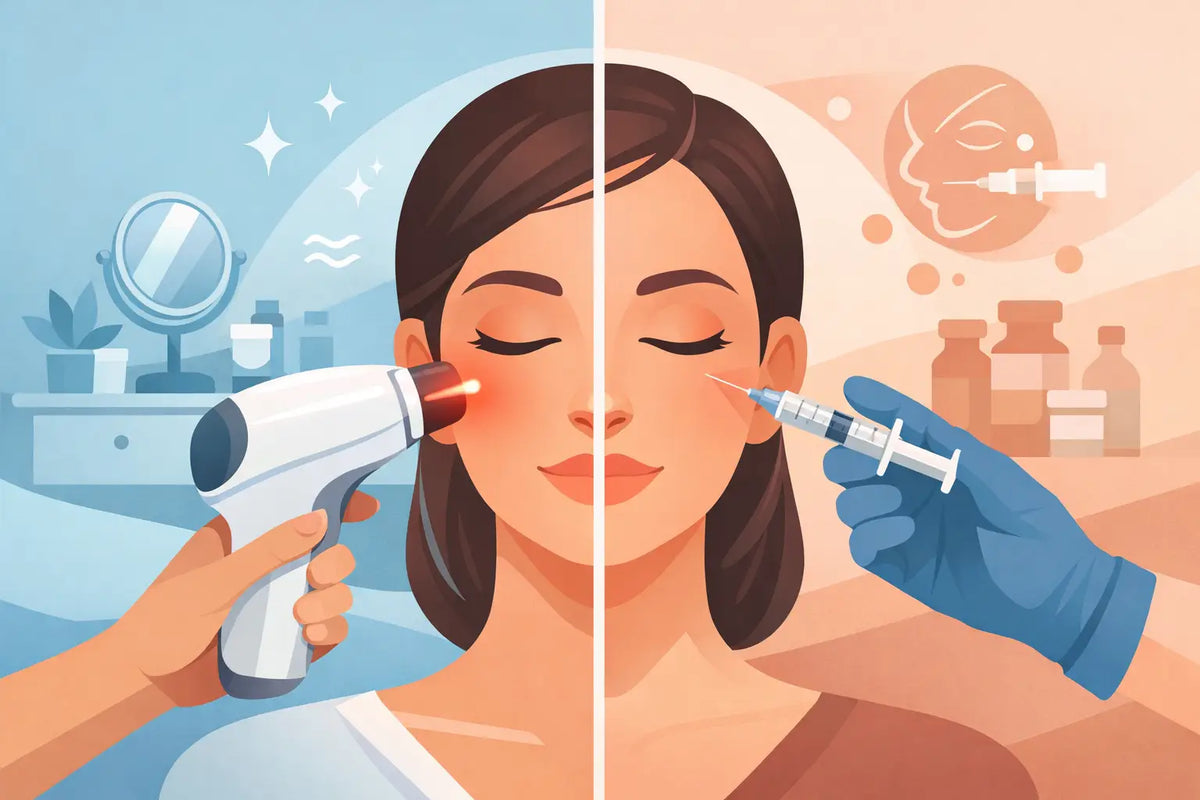
A forehead line that looks deeper by 4 p.m. is not always a Botox problem. It may be a collagen problem, a skin-quality problem, or both. The home laser vs Botox decision becomes much clearer when you stop treating these options as interchangeable and start looking at what each one is designed to change.
Botox can soften wrinkles created by repeated facial movement. A clinical-grade at-home laser is designed to stimulate collagen, helping improve the look of fine lines, skin firmness, and overall texture over time. Both can belong in a thoughtful anti-aging plan, but they work through entirely different pathways.
Home Laser vs Botox: Two Different Approaches to Wrinkles
Botox is a brand name for botulinum toxin, a prescription injectable administered by a qualified medical professional. It temporarily relaxes selected facial muscles, reducing the repeated contractions that create dynamic lines. Think of the vertical lines between the brows, horizontal forehead lines, and crow's-feet that appear more strongly when you frown, raise your eyebrows, or smile.
A home laser does not relax muscle movement. Instead, a non-fractional laser delivers controlled light energy to support the skin's natural collagen-building response. Collagen is the structural protein that gives skin much of its cushion, resilience, and smooth appearance. As collagen declines with age, skin can begin to look thinner, less firm, and more creased even when your face is at rest.
That distinction matters. Botox is primarily a muscle-modulating treatment. A home laser is a skin-quality treatment. If your concern is a line that appears only when you make an expression, Botox may be the more direct option. If you are noticing fine lines at rest, crepey texture, or a gradual loss of firmness around the eyes and mouth, collagen stimulation may be the more relevant starting point.
What Results Look Like and When to Expect Them
Botox is known for speed. Many people begin to see a change within several days, with results typically settling in around two weeks. The smoother appearance is temporary, often lasting roughly three to four months before muscle activity gradually returns. Maintaining the look generally requires repeat appointments and repeat injections.
At-home laser results are more gradual because collagen remodeling takes time. With consistent use according to the device protocol, changes in the appearance of fine lines and skin texture may begin to emerge over several weeks, with continued improvement often becoming more visible over the following months. The payoff is not a sudden frozen-smooth effect. It is a progressive improvement in how the skin itself looks and feels.
This makes timing a useful decision tool. If you have an event in two weeks and want to soften pronounced expression lines, an injector can help you discuss a faster path. If you want to make a long-term investment in firmer-looking, smoother skin from home, a laser routine better matches that goal.
The Best Choice Depends on the Type of Wrinkle
Dynamic wrinkles are driven by muscle movement. They tend to show up most clearly during expression and often respond well to neuromodulators such as Botox. Static wrinkles remain visible when the face is relaxed. They are often connected to collagen loss, sun exposure, repeated movement over many years, and changes in skin hydration and elasticity.
Most mature skin has a mix of both. That is why someone may be pleased with smoother forehead movement after Botox but still notice fine lines, texture, and laxity in the surrounding skin. Muscle relaxation alone does not replace lost collagen or directly improve skin texture.
A home laser can be especially compelling for the delicate eye area, where fine lines may become visible before deeper expression lines take over. It can also support a broader routine focused on skin quality rather than one isolated wrinkle. For consumers who prefer a noninvasive approach, the ability to complete a focused treatment at home can turn consistency from an aspiration into a realistic habit.
NIRA's FDA-cleared, non-fractional laser technology is designed for this category of concern: supporting collagen production to visibly reduce the look of wrinkles without needles, appointments, or recovery time.
Cost, Convenience, and Commitment
Botox is an ongoing professional service. Costs vary based on geographic location, provider expertise, treatment area, and the number of units used. For some people, the in-office experience and relatively quick result justify that recurring investment. For others, appointments, maintenance, and injection costs create friction that makes consistency harder.
A home laser requires an upfront device investment and a commitment to regular use. The trade-off is control over your routine. There is no commute, waiting room, or need to schedule treatments around a professional appointment. A brief, repeatable session can fit before bed, after a shower, or into the same rhythm as your evening skincare.
Neither option should be viewed as effortless. Botox requires periodic maintenance. Laser treatments require discipline. The best choice is often the one you can use or maintain consistently enough to see its intended benefit.
Safety Is Not a Footnote
Botox should only be administered by an appropriately licensed and experienced medical professional. A qualified provider can assess your facial anatomy, discuss realistic outcomes, and help reduce the risk of unwanted effects such as asymmetry, bruising, or temporary eyelid or brow changes. Tell your provider about medications, medical conditions, prior treatments, pregnancy, breastfeeding, and any history of reactions before treatment.
At-home laser technology also deserves a careful approach. Use only a device cleared for its intended use, follow the instructions exactly, and do not assume every light-based device delivers the same technology or outcome. At-home laser, LED, IPL, and professional resurfacing treatments are distinct categories with different mechanisms, treatment experiences, and suitability considerations.
If you have a skin condition, take photosensitizing medications, have recently had a procedure, or are unsure whether a laser is appropriate for your skin, consult a dermatologist or healthcare professional first. The right routine should feel empowering, not uncertain.
Can You Use a Home Laser and Botox Together?
For many people, these treatments are complementary rather than competitive. Botox can address the muscle activity behind dynamic lines, while a home laser can support smoother-looking, more resilient skin through collagen stimulation. One targets movement. The other targets the skin's underlying quality.
The key is coordination. If you receive injectables, ask your provider about timing around any at-home device routine and follow both the provider's guidance and your device instructions. Do not treat more technology as automatically better. A focused plan built around your concerns, budget, and tolerance for maintenance will outperform a crowded routine you cannot sustain.
Choosing the Right Starting Point
Start with the mirror test: relax your face completely. If your main concern fades when you stop moving, speak with a qualified injector about whether Botox is appropriate. If the lines and texture remain visible at rest, collagen-focused skincare may deserve more attention.
Then consider the experience you want. Botox is professional, targeted, and fast-acting, but temporary and appointment-based. A home laser is gradual, noninvasive, and routine-driven, with the potential to support a broader improvement in the look of aging skin over time.
You do not need to choose the most dramatic option to make meaningful progress. Choose the approach that addresses what you actually see in the mirror, fits your lifestyle, and gives you a routine you will feel confident maintaining.


