

Clinical evidence · 7-month study · 76 participants
Every at-home skincare device promises results. Very few of them have been handed to a group of strangers, used every day for four months, and then photographed and graded by independent clinicians who had no idea which photo came first.
Ours has.
In 2019, our clinical team ran a seven-month study on the NIRA Skincare Laser to answer one question as honestly as we could: does a low-power, at-home 1450nm laser actually reduce the appearance of wrinkles?
Here's what the study found — the good, the modest, and the caveats.
How the study was designed
Seventy-six participants between the ages of 35 and 65 enrolled. They used the NIRA laser at home, once a day, around the eye area (the periorbital region — where fine lines tend to show up first and are hardest to treat). Treatment ran for 16 weeks. Then participants stopped using the device entirely and were followed for another 12 weeks, so we could see whether results held.
Total study length: 28 weeks. Sixty-seven participants completed every protocol requirement.
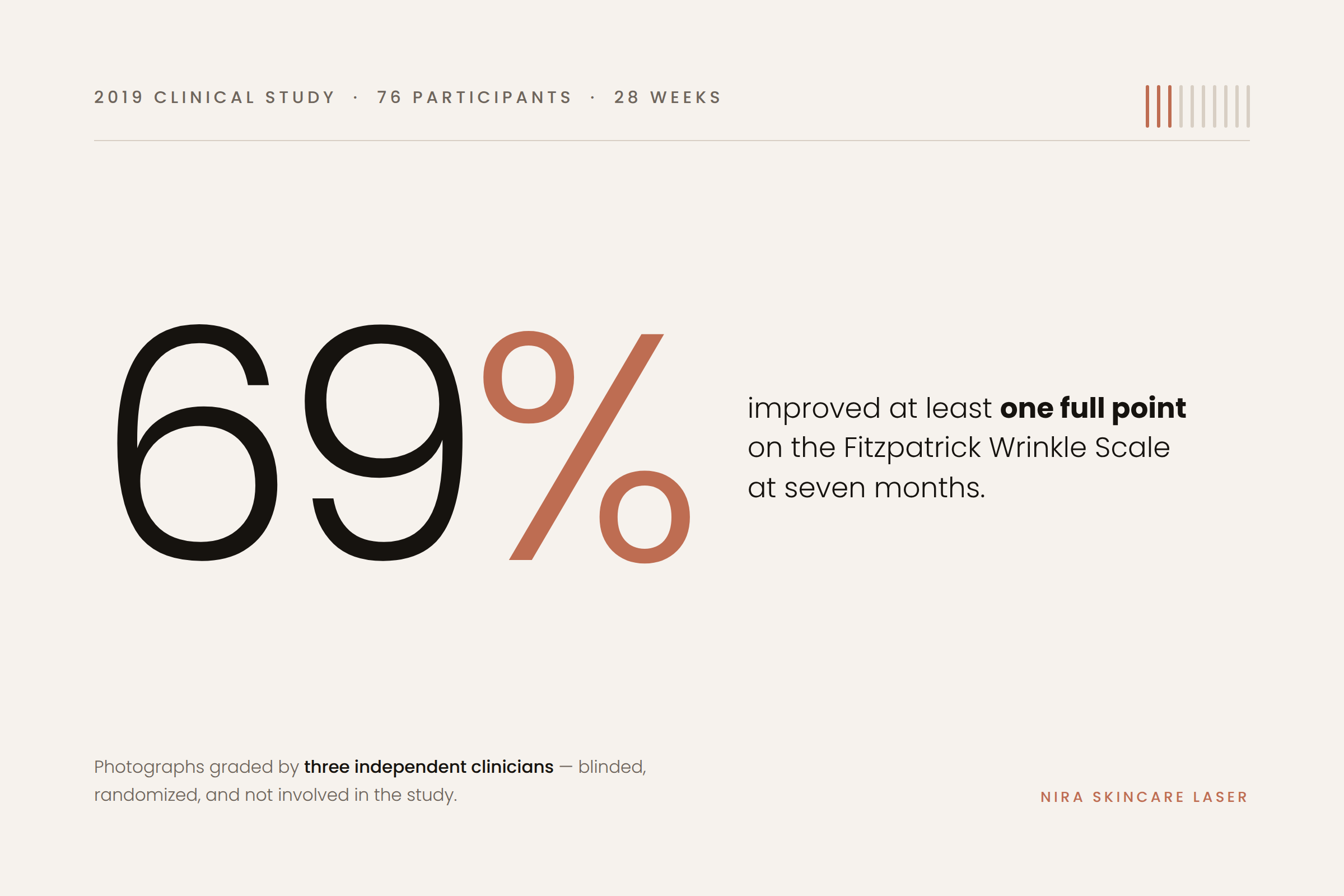
The part that matters most: results weren't graded by us. High-resolution photographs were taken at every clinic visit by a professional photographer under identical studio lighting. Those photos were then scored on the Fitzpatrick Wrinkle Scale by three independent clinicians who were not involved in the study — shown the images in randomized order, blinded to which photo was taken before treatment and which was taken after.
That design is deliberately unflattering to us. It removes the two things that make most before-and-after marketing meaningless: cherry-picked photos and graders who know what they're supposed to see.
What the study found
Across the study, the blinded evaluators recorded a median improvement of a full point on the Fitzpatrick Wrinkle Scale, with a p-value of less than 0.0001. In plain terms: the improvement was statistically significant, not a rounding error, and not chance.
One point on the Fitzpatrick scale is a real, visible category shift — not a subtle tweak only a machine could detect.
Broken out by how long people had been treating:
| Time point | Improved at least 1 full point | Improved at least 2 full points |
|---|---|---|
| 3 months | 61% of participants | 12% of participants |
| 7 months | 69% of participants | 36% of participants |
At the 7-month mark, 10% of participants had improved by three full points on the scale.
Two things stand out there. First, most participants who responded were already seeing a measurable change at three months. Second, the people who kept going kept improving — the 2-point group tripled between month three and month seven.
The finding we didn't expect
Remember that participants stopped treatment at week 16 and were simply observed for the following three months.
The three blinded clinicians found that 81% of participants were still showing improvement in the appearance of wrinkles at least two months after they stopped using the device, and 68% were still showing improvement at least three months after stopping.
Results didn't snap back the moment the device went in a drawer.
Why low power is the point, not a compromise
It's fair to ask how a handheld device does anything a clinic laser does.
The NIRA laser uses the same 1450nm wavelength found in professional non-ablative systems — a wavelength absorbed by water in the skin, which lets it reach the dermal layer where collagen lives, while leaving the surface of the skin intact.
The difference is the energy. Professional 1450nm treatments in published trials typically deliver between 7.0 and 20.0 J/cm². NIRA delivers 2.5–3.0 J/cm².
That's by design. Our Precision Protein Promotion (P3) technology warms the dermis past the threshold that triggers heat-shock protein generation — the skin's own collagen remodeling response — while staying below the roughly 45°C point where treatment starts to hurt. The laser heats quickly, then dynamically lowers its own output to hold temperature in that window.
Most clinic and at-home lasers take the opposite approach: high energy on about 10% of the skin in a dot-matrix pattern, deliberately damaging small zones and letting the surrounding tissue heal them. It works, but the localized pain and redness are exactly why a lot of people never book the appointment twice.
NIRA is non-fractional and single-pass: gentle, even warmth across the whole treatment area, in a short daily session.
What about safety?
The study reported no unanticipated or severe adverse events.
A small minority of participants reported skin warmth, minor stinging, dryness, and temporary darkening of skin color — all anticipated, all temporary. The study also found no data showing adverse events attributable to Fitzpatrick skin type V or VI.
Participants were instructed to set the power level (1 through 5) so that treatment felt warm without any pain.
And did people actually like using it?
Efficacy is only half of whether a daily-use device works. If it's a chore, it ends up unused. From the anonymous participant satisfaction survey:
- 99% found the NIRA laser easy to use
- 87% said they enjoyed using it
- The large majority said they would recommend it to a friend
The honest summary
The 2019 study did not find that NIRA erases wrinkles, and we won't tell you it does. What three independent, blinded clinicians did find is that a low-power 1450nm laser, used at home in a short daily session, produced a statistically significant, visible reduction in the appearance of periorbital wrinkles for the majority of participants — without the pain, downtime, or cost of a clinic appointment — and that those results largely held for months after treatment stopped.
The consistent variable was consistency. The people who used it daily, and kept using it, saw the biggest change.
Ready to start your own four months?

Read the full clinical paper
We're publishing the study in full rather than summarizing it and asking you to take our word for it. Every figure quoted above appears in the source document.
Bean, D., Huang, Z., Feldchtein, F., & Govoni, K. (2019). Non-Fractional Dynamic Treatment of Wrinkles with Low Power, Single-Pass 1450nm Handheld Laser. Dermal Photonics Corp. (NIRA Brand), January 20, 2019.
Individual results vary. All figures cited are outcomes observed among participants in the 2019 clinical study described above and are not a guarantee of individual results. The NIRA Skincare Laser is FDA-cleared and intended for the temporary reduction in the appearance of fine lines and wrinkles. Not intended to diagnose, treat, cure, or prevent any disease.


