

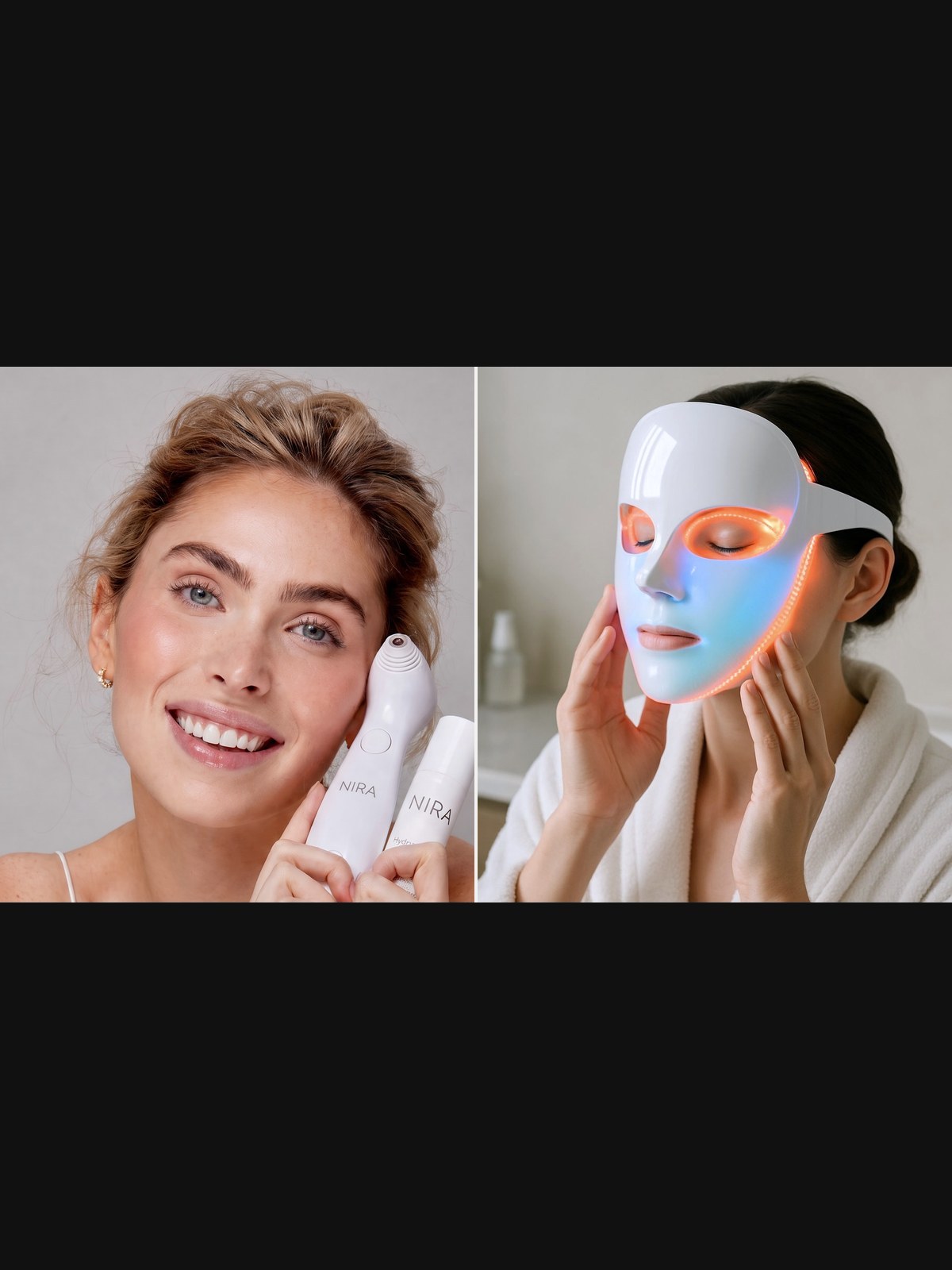
The technology looks similar — light, applied to the face, at home, without needles. They are not similar. One raises the temperature of your dermis into the narrow band where collagen renewal is triggered. The other does not raise it at all. Here is what four clinical studies, one independent peer-reviewed trial, and the underlying physics have to say about the difference between LED masks and the NIRA non-fractional laser technology.
Same category. Different physics. Very different results.
If you only read one thing, read this table. Everything below is the evidence behind it.
| LED masks | NIRA laser | |
|---|---|---|
| Light source | LED arrays, 620–850 nmRed, near-infrared, sometimes blue | Laser diode, 1450 nmSingle wavelength, collimated |
| Absorbing target | Cytochrome c oxidase in mitochondria | Water in the dermal matrix |
| Mechanism | Photobiomodulation — a biochemical nudge | Photothermal — heat-shock protein cascade |
| Peak dermal temperature | ~35°C below any thermal threshold | up to 45°C inside the 39–45°C HSP window |
| Power density | 0.025–0.070 W/cm² | 12.5 W/cm² |
| Session length | 9–15 minutes | 2–3 minutes |
| FDA clearance for wrinkles | Mostly cleared without wrinkle-specific trials | Cleared, K163167 & K222685 |
| Blinded-grader wrinkle evidence | Independent trial found no significant difference | Significant at every post-baseline visit |
| Best-supported benefits | Radiance, tone evenness, acne, inflammation | Wrinkles, firmness, texture, dark circles |
| Typical price | $269–$2,700 | $449–$649 |
Two different physics wearing the same marketing language
Both technologies are sold as “light therapy.” Both are painless. Both are used at home. That is where the similarity ends, because they are trying to do fundamentally different things to your skin.
LED Mask: Photobiomodulation
An LED mask floods the face with red (around 630–660 nm) and near-infrared (around 830–850 nm) light. Those photons are absorbed by cytochrome c oxidase, an enzyme in the mitochondrial respiratory chain. The proposed effect is a modest uptick in cellular ATP production and a shift in reactive oxygen signalling — a biochemical nudge toward better cell function. Crucially, this is an athermal process. It is designed not to heat tissue. LED mask surface temperatures top out around 35°C, which is roughly the temperature of your face on a warm day.
NIRA: Photothermal collagen induction
NIRA does something categorically different. At 1450 nm, the dominant chromophore is not an enzyme — it is water, which makes up the bulk of the dermal matrix. 1450 nm sits on a local absorption peak of water, which means the energy is deposited in the upper dermis rather than passing through it. That deposition raises dermal temperature above 39°C, and above 39°C fibroblasts begin producing heat-shock proteins. The HSP cascade is what signals the body to lay down new collagen and remodel the existing matrix. It is the same mechanism a dermatologist's 1450 nm Candela Smoothbeam relies on — delivered in daily sub-pain-threshold doses instead of one painful monthly session.

This is the point most comparisons miss. Red and near-infrared light actually penetrates deeper than 1450 nm does — that is exactly why it sits in what physicists call the optical window. But penetration without absorption is not treatment. Light that passes through the dermis leaves nothing behind.
Everything comes down to a six-degree band
Human skin has two temperatures that matter for collagen renewal. At roughly 39°C, dermal fibroblasts begin expressing heat-shock proteins, which trigger procollagen type I and III synthesis. At roughly 45°C, thermal nociceptors fire and the treatment becomes painful; push further and you cause frank thermal injury, which is what produces the erythema and downtime of professional resurfacing.
The entire engineering problem of at-home laser skincare is landing inside that six-degree band and staying there long enough to matter. NIRA's dynamic fluence modulation does exactly this: it drives power hard to climb quickly, then throttles back to hold the dermis just under 45°C, keeping tissue above the HSP threshold for three-plus seconds per pulse from a sub-one-second treatment.

An LED mask cannot execute this strategy, and not because of poor engineering. It is a consequence of the wavelength and the power budget. Which brings us to the number that explains the whole comparison.
Joules are not the metric. Watts per square centimetre are.
Here is a genuinely counterintuitive fact: over a full session, an LED mask can deliver a comparable number of joules to a NIRA treatment. An LG LED mask at 0.025 W/cm² running for nine minutes delivers about 13 J/cm². A NIRA treatment delivers about 3 J/cm² per spot. On a pure energy basis, the mask wins.
It still does nothing for wrinkles, and the reason is rate. Living tissue is actively cooled by blood perfusion. Deliver energy slowly enough and circulation carries the heat away exactly as fast as it arrives, so tissue temperature never rises. To heat tissue you must deposit energy faster than the body can remove it. That is a question of power density, not total energy — and on power density the gap is not close.
A kettle and a candle can deliver the same joules. Only one boils water.
Leave a candle under a pot all afternoon and you will transfer an enormous amount of energy into the room. The water never boils, because heat leaves the pot as fast as the candle adds it. This is precisely the relationship between an LED mask and a laser at the level of the dermis.
An LED mask is not a weak laser. It is a different instrument attempting a different job. It should be judged on the outcomes photobiomodulation can plausibly produce — and, as we cover below, there are several real ones.
Two studies, seven years apart, under the same investigator
NIRA has run two clinical studies of its non-fractional 1450 nm platform, both supervised by Dr. David Greenstein. The 2019 study tested periorbital treatment; the 2025 study extended to the full face with the M2.1 device. Both ran 28 weeks: 16 weeks of daily treatment followed by a 12-week observation period with no laser use at all.
| 2019 study | 2025 study | |
|---|---|---|
| Treatment area | Periorbital only | Full face |
| Enrolled / completed | 76 / 67 | 60 / 51 |
| Per-protocol population | 67 | 48 |
| Duration | 28 weeks | 28 weeks |
| Spot size | 4 × 4 mm | 19.07 × 15.08 mm |
| Fluence | 2.5–3.3 J/cm² | 1.37–4.88 J/cm² |
| Daily protocol | 40–60 pulses per eye | ~80 pulses, full face |
| Primary endpoint | Fitzpatrick Wrinkle Scale, three independent blinded clinicians, randomised baseline vs endpoint | |
| ≥1 point FWS improvement | 68.7% (46/67) | 58% (28/48) — 67% in the FWS≥5 subset |
| Statistical significance | p < 0.0001 | p = 0.018 (t-test and Wilcoxon) |
| Serious adverse events | None reported in either study | |
Results continued improving after treatment stopped
This is the finding that most distinguishes a collagen-remodelling mechanism from a cosmetic one. Participants stopped using the laser at Week 16. Their wrinkle scores kept improving through Week 28. That is the signature of a structural change in the dermis rather than a temporary surface effect — new collagen takes months to organise and mature.
The 2019 study saw the same pattern: three independently blinded professionals found that 81% of participants continued to improve for at least two months after stopping, and 68% continued improving for at least three months.
Wrinkles were not the only endpoint
The 2025 study measured nine skin-quality parameters using VISIA complexion imaging, Delfin instrumental firmness and elasticity measurement, and AI-based photographic analysis.


| Survey item | % agree |
|---|---|
| App easy to use and intuitive | 100% |
| Device easy to use | 99% |
| App reliable and stable | 98% |
| Would continue as a daily routine | 95% |
| Would recommend NIRA to others | 92% |
| Felt their skin had improved | 91% |
Therabody ran the same study twice. The results moved sharply.
Therabody deserves credit here. Most LED mask brands publish no wrinkle-specific clinical data at all. Therabody has published two studies and made the results public — which is precisely what makes them the most useful LED comparator available.
The 2023 study evaluated the TheraFace Mask in 31 subjects over 12 weeks. The 2025 study evaluated the TheraFace Mask Glo in 104 subjects over 12 weeks — described by the company, accurately, as the largest clinical study of any LED mask on the market. Same brand. Same duration. Same category of graded endpoint.
This pattern is familiar to anyone who reads clinical literature. Small samples produce large, unstable effect estimates; larger samples regress toward the true value. The 2025 study is the better estimate, and it is Therabody's own. It is also the number NIRA uses in every comparison below, because using the weaker 2023 figure would flatter the LED case with the less reliable data.
| Endpoint | Average change | Subjects improving |
|---|---|---|
| Radiance and luminosity | +25.4% | 84% |
| Skin texture smoothness | +22.9% | — |
| Firmness (expert clinical grading) | +13.5% | 87% reported |
| Skin tone evenness | +11.0% | 75% |
| Visible skin sagging | −10% | — |
| Full-face fine lines | +4.0% | 80% reported |
| Wrinkle width | +2.8% | 10% |
Read that table carefully, because it tells a coherent and honest story about what LED does well. The strongest results are radiance, texture and tone — surface and pigmentary qualities. The weakest result by a wide margin is wrinkle width, the endpoint most directly tied to dermal collagen architecture. That is exactly the pattern the underlying physics predicts. A treatment that never heats the dermis produces limited structural change in the dermis.
Both brands' 2025 studies, on the same question
Comparing the most recent, largest study from each brand on their respective wrinkle endpoints:
Two separate factors drive the difference, and it is worth separating them because they mean different things to a prospective buyer. The first is how likely you are to respond at all. The second is how much change you get if you do. Multiplying them gives the expected effect across a population of users.
What this comparison can and cannot claim
Intellectual honesty matters more than a large number, so here is the fine print in full. These are two independent studies, not a head-to-head randomised trial, and they differ in ways that matter:
- Different instruments. NIRA's 93% / 21% figures come from AI-based photographic analysis and VISIA imaging. Therabody's 10% / 2.8% come from their expert clinical grading of wrinkle width. These are not the same measurement scale.
- Different durations. NIRA's endpoint is Week 28 after 16 weeks of treatment. Therabody's is Week 12. NIRA's own data show results still climbing between Week 12 and Week 28, so a Week-12-to-Week-12 comparison would narrow the gap.
- Different populations. NIRA's 2025 cohort had a median age of 64 and required baseline FWS ≥ 4. Therabody's inclusion criteria differ.
- Different sample sizes. Therabody's 104 subjects exceed NIRA's 48 per-protocol population.
What the comparison does support: on each brand's own chosen wrinkle endpoint, measured by that brand's own methodology, the difference in outcome is very large and is directionally consistent with the mechanism. A precise multiplier of 70 should be read as an order-of-magnitude statement, not a measured constant.
What happened when neutral dermatologists graded LED blind
Manufacturer studies — including NIRA's — carry an obvious structural interest in their own results. So the most valuable evidence in this entire comparison comes from neither company.
In 2017, Nam and colleagues at Dankook University published a prospective, randomised, double-blinded comparative clinical trial in Dermatologic Surgery, evaluating 660 nm red LEDs against 411–777 nm white LEDs for facial wrinkles. 52 adult women were irradiated daily for 12 weeks. It was funded by a Korea Health Industry Development Institute grant, not by a device manufacturer.

Instrumented skin-replica measurement did detect statistically significant change from baseline. But in the arm that most closely reflects what a user actually sees — blinded dermatologists grading randomised before-and-after photographs — the authors report: “no significant differences were observed in both groups.”
This is the single most important methodological point in the whole comparison. Instrumented measurements of surface topography can register changes that no human observer can see. Blinded photographic grading by independent clinicians is the harder test, and it is the standard NIRA's own primary endpoints were held to in both 2019 and 2025 — where the result was statistically significant improvement at every post-baseline visit.
The compounding argument
A single professional 1450 nm session delivers roughly 18 J/cm² and then you wait a month. NIRA delivers roughly 3 J/cm² a day. Over a month that is 90 J/cm² — about five times the dermal energy of a professional visit, spread thin enough that it never crosses into pain or downtime.
Then there is the cost nobody prices: your time. A 12-minute daily mask session is a meaningful commitment. Across a year it adds up to more than sixty hours.
| Approach | Per treatment | Year one | Thereafter |
|---|---|---|---|
| NIRA laser | $449–$539 | $449–$649 | Device is yours — no recurring cost |
| LED mask | $269–$2,700 | $269–$2,700 | Device is yours |
| In-office laser | $570–$2,000 | $2,250–$12,000 | Repeats yearly |
| Neurotoxin injections | $960–$1,500 | $3,840–$6,000 | Repeats every 3–4 months |
| Dermal fillers | $3,400–$6,800 | $6,800–$13,600 | Repeats every 6–18 months |
Where LED genuinely earns its place
A comparison that concludes one technology is better at everything is usually a comparison you should distrust. LED masks do real things, and Therabody's own 2025 data show what those things are.
| If your primary concern is… | LED mask | NIRA laser |
|---|---|---|
| Wrinkles and fine lines | Weak | Strong |
| Skin firmness and elasticity | Moderate | Strong |
| Radiance and luminosity | Strong | Moderate |
| Uneven tone and pigmentation | Strong | Moderate |
| Active inflammatory acne | Strong blue light, antibacterial | Strong 1450 nm targets sebaceous glands |
| Post-procedure inflammation | Strong | Not indicated |
| Completely hands-free routine | Yes | Requires active use |
| Shortest daily time commitment | 9–15 min | 2–3 min |
| Treating neck, chest and hands | Mask geometry limits this | Handheld, any area |
There is a defensible case for using both. LED for inflammation, radiance and tone; a 1450 nm laser for the structural collagen work. They are not substitutes, and treating them as competitors in the same category is a marketing artefact rather than a clinical reality.
If wrinkles are the goal, the mechanism decides the outcome
Strip away the marketing from both sides and the argument reduces to one question: does the device get your dermis into the 39–45°C window where collagen renewal is signalled?
An LED mask does not, by design. It operates at roughly 35°C and 0.025–0.070 W/cm². Its published results reflect that honestly — strong on radiance and tone, weak on wrinkle architecture. A 1450 nm non-fractional laser does, deliberately, holding tissue above the heat-shock threshold for three-plus seconds per pulse without crossing into pain.
Buy the mechanism that matches the problem.
For radiance, tone evenness and inflammatory calm, an LED mask is a reasonable purchase with real published support behind those specific claims.
For wrinkles, fine lines and dermal firmness, the evidence points clearly to photothermal collagen induction — 93% of NIRA subjects showing measured wrinkle improvement against 10% in the largest published LED mask study, in a fifth of the daily time, with results that continued improving for three months after treatment stopped.

Common questions
Is an LED mask useless, then?
No. It is mis-marketed. Therabody's own 2025 data show meaningful improvements in radiance (+25.4%), texture (+22.9%) and tone evenness (+11.0%). Those are real benefits from a real mechanism. The problem is that masks are sold primarily on wrinkle reduction, which is the endpoint where the same study found a 2.8% average change and a 10% responder rate.
Doesn't red light penetrate deeper than 1450 nm?
Yes, and it is a common misunderstanding that this favours LED. Red and near-infrared sit in tissue's optical window precisely because they are poorly absorbed — which is why they travel far. 1450 nm is strongly absorbed by water, so it deposits its energy in the upper dermis instead of passing through. For collagen stimulation, absorption at the right depth beats raw penetration.
Why does NIRA use the weaker Therabody study rather than the stronger one?
Because the 2025 study is the more reliable estimate. It enrolled 104 subjects against 31 in 2023, and larger samples produce more trustworthy effect sizes. Using the 2023 figures would produce a smaller, more flattering-to-LED gap built on weaker data. We would rather be compared against Therabody's best evidence.
Is the 70× figure a measured result?
No, and we say so plainly. It is the product of two ratios drawn from two separate studies with different measurement instruments, durations and populations. Read it as an order-of-magnitude statement about the difference in mechanism, not as a precise constant. The full caveats are set out in Section 06.
Is a home laser safe to use on my own face?
1450 nm is strongly absorbed by water, which makes it eye-safe for most applications, and it has very low absorption in melanin, haemoglobin and cellular DNA. NIRA devices carry three contact sensors requiring full skin contact before firing. Across four clinical studies no serious adverse events have been reported; roughly 2–5% of users report mild transient discomfort. The devices are FDA cleared and tested to IEC 60601-1, IEC 60825 and ISO 14971.
How long before I see anything?
In the 2025 study 31% of subjects had a full point of Fitzpatrick Wrinkle Scale improvement by Week 8, 46% by Week 12, and 63% by Week 16. Plan on 90 days of daily use before judging results, and expect continued improvement after that.
Can I use both an LED mask and a NIRA laser?
Yes. They act through different mechanisms on different targets and there is no known interaction. If you own a mask you value for radiance or breakouts, there is no reason to abandon it.
References and methodology
Primary clinical sources
- Greenstein D, Bean D, Nale H, Wong R, Jiang H. Non-Fractional, Home-Use 1450 nm Laser Treatment for Full-Face Wrinkles and Facial Rejuvenation: A 28-Week Clinical Study. NIRA Innovations Inc., February 2026.
- Bean D, Huang Z, Feldchtein F, Govoni K. Non-Fractional Dynamic Treatment of Wrinkles with Low Power, Single-Pass 1450 nm Handheld Laser. Dermal Photonics Corp., January 2019.
- Nam CH, Park BC, Kim MH, Choi EH, Hong SP. The Efficacy and Safety of 660 nm and 411 to 777 nm Light-Emitting Devices for Treating Wrinkles. Dermatologic Surgery 2017;43(3):371–380. DOI: 10.1097/DSS.0000000000000981.
- Therabody. The Clinical Findings Behind TheraFace Mask Glo — the Largest Study of LED Masks on the Market. 12-week study, 104 subjects. therabody.com
- Therabody. TheraFace Mask LED Therapy Skincare Device Is Clinically Proven as a Facial Health Solution in 12-Week Clinical Study. 31 subjects. therabody.com
Mechanism and supporting literature
- Dams S, et al. Heat shocks enhance procollagen type I and III expression in fibroblasts in ex vivo human skin. Skin Research and Technology 2011;17(2):167–180.
- Goldberg DJ, Rogachefsky AS, Silapunt S. Non-ablative laser treatment of facial rhytides: 1450 nm diode laser with dynamic cooling. Lasers in Surgery and Medicine 2002;30(2):79–81.
- Tanzi EL, et al. Treatment of inflammatory facial acne vulgaris with the 1450 nm diode laser: a pilot study. Dermatologic Surgery 2004;30(2):147–151.
- Astner S, Tsao SS. Clinical evaluation of a 1450 nm diode laser as adjunctive treatment for refractory facial acne vulgaris. Dermatologic Surgery 2008;34(8):1054–1061.
- Lloyd JR, et al. 1440 nm Nd:YAG laser for the treatment of facial wrinkles. Lasers in Surgery and Medicine 2010;42(5):384–391.
Device specifications
Power density, energy density, spot size, treatment time and maximum skin temperature figures are drawn from NIRA's competitive technology analysis, compiled from manufacturer published specifications and FDA 510(k) summaries: NIRA (K163167, K222685), Tria (K130459), Candela/Cynosure (K041242), NuFACE (K201680, K120560), LYMA (K210823), LG (K170984), Silk'n (K162784), Tripollar/Newa (K203665).
A note on method
Every LED figure in this article comes from the manufacturer's own published clinical summaries, not from third-party estimates or reconstructions. Where two studies from the same brand disagree, we have used the larger and more recent one. Where NIRA and LED endpoints are not directly comparable, we have said so explicitly rather than presenting the comparison as equivalent. Percentages are reproduced as published.


