

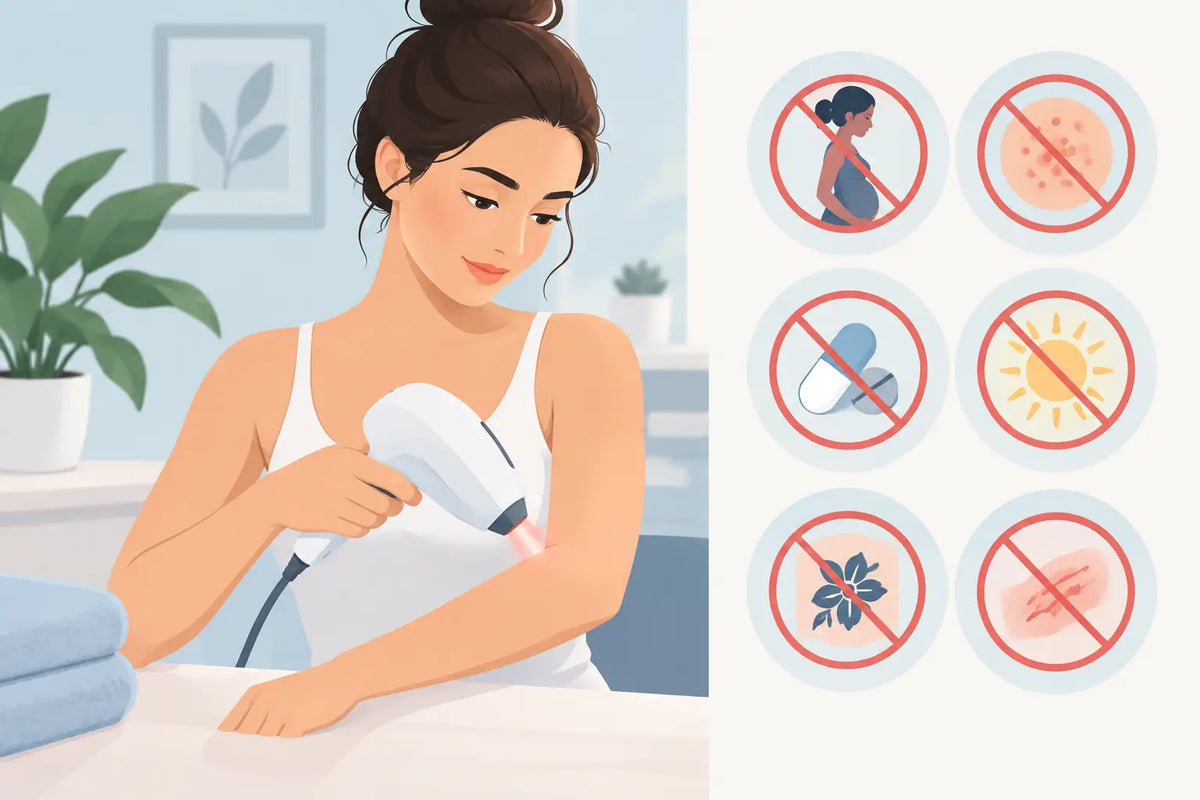
A facial laser should feel like a confident step forward in your skin routine, not a guessing game. This guide to laser contraindications clarifies when an at-home laser treatment may be appropriate, when it should wait, and when a conversation with your physician or dermatologist comes first.
At-home laser technology can be a powerful way to support smoother-looking skin and visible collagen renewal on your own schedule. But every device has specific instructions, intended uses, and safety information. Reading the labeling for your exact device is not a formality - it is how you protect your skin and get the best possible experience from your treatment.
What Does “Laser Contraindication” Mean?
A contraindication is a condition, medication, treatment, or circumstance that means you should not use a device, or should use it only after medical guidance. Some contraindications are permanent. Others are temporary, such as a healing rash, a recent cosmetic procedure, or a medication that increases sensitivity to light.
The key distinction is that not every precaution means laser treatment is off the table forever. It may simply mean pressing pause until your skin has recovered, your medication course is complete, or your clinician has confirmed that treatment is appropriate.
Laser safety is device-specific. A clinical in-office laser and an FDA-cleared at-home, non-fractional facial laser do not necessarily have the same treatment parameters or restrictions. Always follow the contraindications and warnings in your device manual over generalized advice online.
Guide to Laser Contraindications: When to Avoid Treatment
Certain situations call for a clear no until you have been evaluated by a qualified healthcare professional. If any of these apply to you, do not assume an at-home device is suitable simply because it is designed for consumer use.
Pregnancy and breastfeeding
Cosmetic laser treatments are commonly avoided during pregnancy because there is limited research on elective laser use in pregnant individuals. This is a precautionary standard, not a judgment about your skincare goals. Wait until after pregnancy, and ask your obstetric provider or dermatologist about use during breastfeeding based on your health history and the device’s instructions.
Active cancer or a history of skin cancer in the treatment area
Do not treat over a suspicious mole, lesion, changing spot, or known skin cancer. Anyone receiving cancer treatment, managing an active cancer diagnosis, or with a history of skin cancer on the intended treatment area should seek clinician guidance before using a cosmetic laser.
A laser device is not a diagnostic tool. It cannot evaluate a spot, and it should never be used to delay a skin exam. If a mark is new, changing, bleeding, crusting, or slow to heal, schedule a professional evaluation first.
Photosensitizing medications
Some medications can make skin more reactive to light or heat. Depending on the medication and device, this can raise the chance of unwanted redness, irritation, pigment changes, or injury.
Examples may include certain acne medications, antibiotics, diuretics, anti-inflammatory medications, antifungals, and medications used for autoimmune conditions. Supplements and topical products can also matter. St. John’s wort, for example, may increase photosensitivity in some people.
Medication names and guidance change, so do not rely on a generic list. Review your prescriptions, over-the-counter medications, supplements, and topical treatments with your pharmacist, prescribing provider, or dermatologist. Ask specifically whether they create photosensitivity and whether an at-home facial laser is appropriate.
Isotretinoin and recent use
Oral isotretinoin requires special attention because it can affect skin dryness, sensitivity, and healing. Recommendations around laser procedures after isotretinoin have evolved, and the appropriate waiting period depends on the treatment type, dose, skin condition, and clinician’s assessment.
For an at-home device, follow the manufacturer’s instructions exactly and get personalized medical clearance before resuming treatment if you are taking isotretinoin or have recently stopped it. Do not use a laser to push through compromised, intensely dry, peeling, or inflamed skin.
Temporary Reasons to Press Pause
Healthy-looking skin is not always ready for treatment. Temporary inflammation and barrier disruption can change how skin responds, even when you have used a laser comfortably in the past.
Pause treatment if you have an active infection, cold sore outbreak, open cut, sunburn, eczema flare, dermatitis, rosacea flare, or unexplained irritation in the area you plan to treat. Treating inflamed skin can intensify discomfort and make it harder to tell whether a reaction comes from the laser, a topical product, or the underlying condition.
Recent sun exposure also deserves caution. If your skin is pink, tender, peeling, or visibly tanned after time outdoors, give it time to recover. Daily broad-spectrum sunscreen and practical sun protection are essential companions to a results-focused anti-aging routine, especially when you are investing in collagen-supporting technology.
Recent procedures can be another reason to wait. Chemical peels, microneedling, injectables, waxing, dermaplaning, surgical procedures, and resurfacing treatments each have different recovery windows. Your provider should tell you when your skin is ready to return to at-home laser use. The right timing protects both your comfort and your investment in professional care.
Conditions That Need Individual Guidance
Some health histories do not create an automatic no, but they do require a more personalized decision. This is where generic skincare advice is not enough.
If you have a history of seizures triggered by light, a condition associated with photosensitivity, lupus, porphyria, vitiligo, keloid scarring, or a pigmentation disorder such as melasma, speak with a dermatologist before treatment. The question is not only whether you can use a laser. It is whether the expected benefit outweighs the chance of a flare, discoloration, or other unwanted response for your skin.
The same applies if you have darker skin tones or a history of post-inflammatory hyperpigmentation. At-home devices may be designed with specific treatment protocols, but skin response is individual. Follow the device’s skin-tone guidance, use the recommended settings and frequency, and do not increase treatment intensity or frequency in pursuit of faster results.
Where You Should Not Use a Facial Laser
Even if you are an appropriate candidate overall, placement matters. Use the device only on the areas named in its instructions for use. Avoid treating directly over the eyes, eyelids, lips, thyroid area, tattoos, permanent makeup, suspicious lesions, or areas with broken skin unless the device labeling explicitly says otherwise.
This is especially relevant around the eye area, where many people notice fine lines first. Precision matters. A device made for facial wrinkle treatment should be used exactly as directed, with the appropriate positioning and protective guidance from its manual.
Do not improvise by using a facial device on the body, scalp, or another concern simply because the technology sounds similar. Different areas have different skin thickness, pigmentation, anatomy, and safety considerations.
Build a Safer At-Home Laser Routine
The strongest results come from consistency, not overuse. Start with clean, dry skin unless your device instructions say otherwise. Remove products that could interfere with treatment or increase irritation, then use the device at the recommended frequency and duration.
Afterward, keep your routine calm and supportive. A hydrating serum and barrier-focused moisturizer can help skin feel comfortable. If you use potentially irritating actives such as retinoids, exfoliating acids, or benzoyl peroxide, check your device instructions and consider separating them from laser-treatment sessions if your skin becomes dry or reactive.
NIRA devices are designed to make clinically informed wrinkle treatment feel practical at home, but confidence starts with following the exact protocol for your device. More sessions, longer sessions, or treating skin that is not ready will not improve results. Precision is part of performance.
When to Stop and Get Help
Mild, short-lived warmth or temporary redness may occur with some cosmetic devices, depending on the device’s instructions. Pain, blistering, prolonged swelling, marked redness, new pigment changes, or a rash are different. Stop using the device and contact a healthcare professional if you experience an unexpected or persistent skin reaction.
If you are unsure whether a medication, diagnosis, procedure, or skin change applies to you, choose the conservative path. Pause treatment and ask a qualified clinician who understands your health history. Beautiful results should never require you to ignore a safety question - they begin with skin that is treated thoughtfully, consistently, and with care.


